
The 2026 Budget's Property Changes: What's Proposed, What's Not Yet In Effect
The national median dwelling price hit $922,838 in February 2026. If you want to understand how Australian property got to that number, the most honest answer is: policy decisions, compounding over four decades.
Every major price move traces back to a policy decision
Australian median dwelling prices 1985 to 2026. Source: ABS, CoreLogic, RBA. Intermediate values interpolated.
The 2026 federal budget proposed two significant changes to that policy environment. They haven't passed Parliament yet. But the cutoff dates are already in effect, and the market is already pricing in the expectation that they will.
What did the 2026 budget propose for negative gearing?
Negative gearing survived 2019, when Labor lost an election largely on the back of proposing to quarantine it. The 2026 budget got through what that earlier proposal couldn't. The proposed change doesn't abolish negative gearing. It restricts it to new builds.
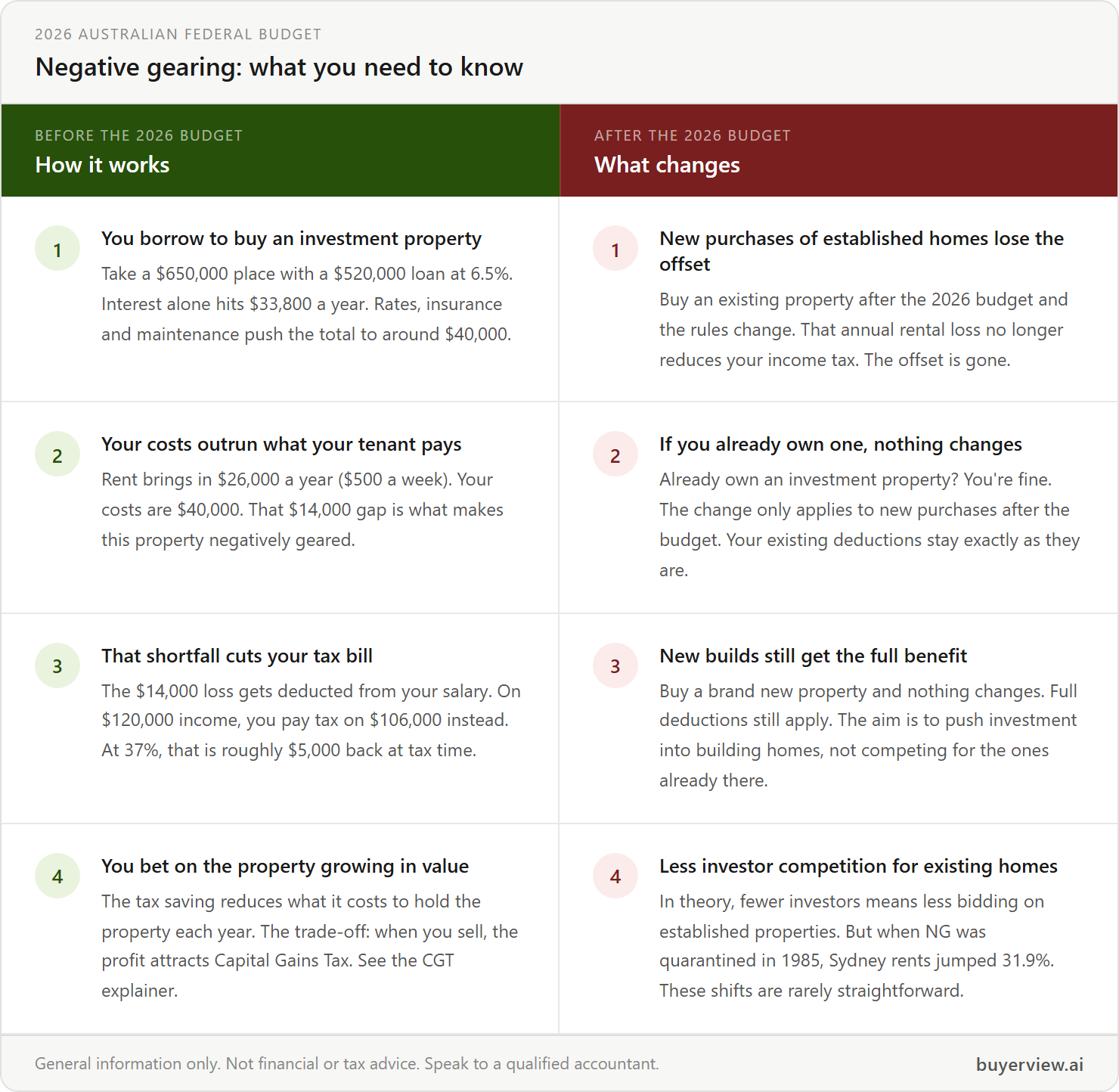
Negative gearing: before and after the 2026 budget proposal.
The cutoff is specific: contracts signed after 7:30pm AEST on 12 May 2026 are subject to the new rules if passed. Properties contracted before that time remain under the existing rules indefinitely.
One thing the explainer doesn't spell out: this is the second time Australia has tried this. The Hawke government quarantined negative gearing on established properties in 1985. Sydney rents jumped 31.9% during that period and the rule was reversed two years later. Whether 2026 follows the same pattern depends on whether investors shift to new builds as intended, or step back from property altogether.
What did the 2026 budget propose for capital gains tax?
Since 1999, holding a property for more than 12 months meant paying CGT on only half the profit. The 2026 budget proposes replacing that 50% discount with a 30% minimum tax on net capital gains, applying from 1 July 2027 if passed. New build investors can choose between the 50% discount or the new arrangement, whichever is more favourable.
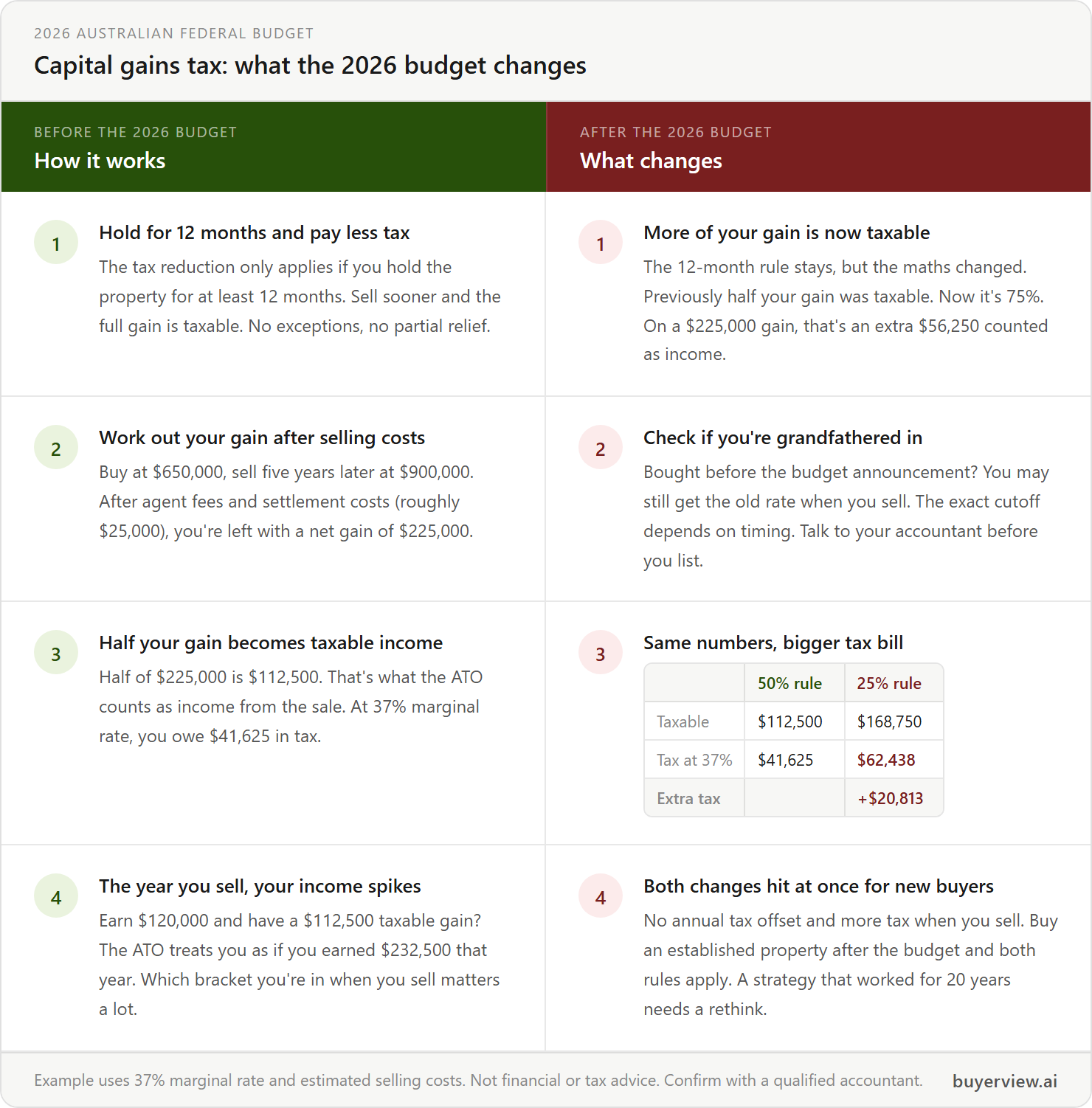
Capital gains tax: what the 2026 budget proposes to change.
Two things worth knowing beyond the explainer numbers. First, the bracket problem: in the year you sell, your capital gain gets added to your total income for that financial year. A large gain on top of a $120,000 salary can push you into the top tax bracket for that year alone. Timing a sale around lower-income years becomes significantly more valuable under the proposed rules.
Second, if you already own investment property bought before the budget: talk to your accountant before you list. The grandfathering provisions are specific to contract date, not settlement date.
What does this mean for buyers of established homes?
Both proposed changes weaken the same investment equation for established properties. No annual tax offset. A larger bill when you sell. The investment case for an established home now relies more heavily on capital growth alone.
For owner-occupier buyers, the picture is genuinely mixed. Less investor competition at auction could ease price pressure. But fewer investors also means less rental supply, and some of those renters are saving for a first home. These adjustments rarely move in one clean direction.
Look at the chart again. Every significant policy shift produced a market response. Sometimes immediately, sometimes 18 to 24 months later. The 2026 proposals are not yet in effect. But the market rarely waits for Parliament.
Frequently asked questions
Are the 2026 negative gearing and CGT changes already in effect?
No. They were announced in the federal budget on 12 May 2026 but still need to pass through Parliament before they take effect. The cutoff dates are set from budget night, but the full legislative detail is still being drafted.
When would the changes take effect if passed?
The negative gearing restriction applies to contracts entered into after 7:30pm AEST on 12 May 2026. The CGT changes are proposed to apply from 1 July 2027.
Does negative gearing still apply if I already own an investment property?
Yes. Properties contracted before 7:30pm AEST on 12 May 2026 remain under the existing rules. Your current deductions are not affected.
Do new builds still qualify for negative gearing and the CGT discount?
Yes. The restrictions only apply to established homes. New build investors retain access to negative gearing and can choose between the existing 50% CGT discount or the new arrangements, whichever is more favourable.
Should I wait to buy or sell until this is clearer?
That depends on your circumstances. Given the legislative uncertainty, speaking to a qualified accountant before making a property decision is more important now than usual.
Disclaimer
General information only. Not financial or tax advice. Legislation is subject to parliamentary approval and may change. Confirm your position with a qualified accountant.
BuyerView helps Australian property buyers ask the right questions, on the record, before they buy. Ask your first question free →