What Happens to Your Deposit When a Developer Collapses
The six questions nobody tells Australian buyers to ask.
The short answer: in most states an off-the-plan deposit is required to sit in a trust or controlled money account rather than go to the developer, so the money usually still exists after a collapse. But a protected deposit is not a refundable one. Getting it back depends on a right to terminate under your own contract, and on knowing which company actually holds it, which is the part most buyers cannot answer.
Six Australian cases from 2023 to 2026, and the question each one turned on.
The deposit nobody could locate
If the company building your home collapsed tomorrow, could you say who is holding your deposit?
Arminder cannot. He paid $30,000 for a block of land in Western Sydney four years ago, and in August 2026 the company he bought it from, Bathla Group, went into voluntary administration.
Administration is not the same as a company closing its doors. Independent administrators take control while they work out whether the business can be saved, and work on some sites has carried on since. But around 1,000 buyer deposits now sit against homes that have stopped, and the administrators told purchasers they were "not presently in a position to refund deposits paid to the companies." The accounts showed $45.7 million in customer deposits against $3.19 billion in liabilities.
So he went looking for his.
In NSW the Conveyancing Act 1919 generally requires off-the-plan deposits to sit in a trust or controlled money account rather than go to the developer, which means his money probably still exists somewhere. Then he read his contract properly for the first time and found three different vendor companies listed on it. Nothing in four years had told him which one received his deposit. Nothing required anyone to.
Four years of waiting. Thirty thousand dollars he cannot reach. And the simplest question about his own purchase, still unanswered.
Before you exchange: which company on this contract receives my deposit, and which trust account holds it? In writing.
Bathla Group is in voluntary administration and no findings of wrongdoing have been made against it. Position as at September 2026.
Two months before any of this, Parliament passed the biggest change to Australian property tax in a generation. Negative gearing gone for established homes bought after 12 May 2026. The capital gains discount replaced. Buyers read every explainer that came out.
Not one word of it helps Arminder.
That is the layer this article is about. At several points in a purchase your money sits with someone else before you own anything, and the rules covering that gap are thinner than most buyers assume. Five more cases, newest first.
The discount that was never money
May bought an apartment off the plan from the same company, at its Marsden Park development, for around $800,000. She found it through a Filipino community Facebook page, where someone had posted about low-deposit home ownership.
The deal was a 5 per cent incentive. She would pay a 5 per cent deposit and the developer would put in another 5 per cent at settlement. The sales material called it a discount. She paid $5,600 to get started.
A discount comes off the price written into the contract. This was a promise to hand over money later, which makes it a debt owed to her by a company that is now in administration. Nothing stopped the sales material describing one as the other, and nothing prompted her to check which she had. She read the contract closely for the first time after the administration began.
If the promise is not honoured she is roughly $40,000 short, at a settlement she cannot walk away from, on a contract with no finance clause.
Then there is the part almost nobody prices in. She signed expecting to move in during early 2025. Settlement is now scheduled for February 2027. Two extra years is not a pause, it is a bill: rent she keeps paying, a deposit sitting idle, an interest-free plan she keeps feeding, and a borrowing capacity that gets reassessed against 2027 rates rather than the ones she planned around. The bank's valuation happens at the end of all that, and close to half of off-the-plan valuations come in under the contract price.
She is not unusual. Construction companies accounted for one in every four company insolvencies in Australia last financial year: 3,472 of them went under in the twelve months to June 2026.
Ask it plainly: does this reduce the price on my contract, or is it money someone promises to pay me later? Only one of those survives an insolvency.
Fifteen thousand dollars for nothing
In May 2026 the buyer's agency Dashdot went into liquidation, two weeks after the federal budget announced the end of negative gearing for established homes. Banks were already pulling back from investor lending. A business built on investor demand met a policy aimed at investor demand.
The creditors' report put the total owed at $16,572,792.80. Of that, $10,594,079 was owed to 695 clients who had paid for work that will now never happen, around $15,200 each. One had paid $23,100. Another $20,790. Against all of it, the liquidators estimated about $70,674 they could actually recover.
Roughly one dollar for every $234 owed.
These people did the responsible thing. They hired a professional instead of guessing.
The sector they hired from is one its own peak bodies call unregulated. "Whilst the industry remains unregulated, these property spruiker types will keep surfacing and operating," said Ben Kingsley of the Property Investors Council of Australia after the collapse. Cate Bakos, who chairs PIPA, pointed at licensing that varies state by state and easier pathways that let in "a flood of these buyer's agents who have limited, if any, experience."
The warning sign was never hidden either. Fifteen to twenty thousand dollars handed over upfront is, in the words of the Real Estate Buyers Agents Association, "an abnormally large amount." Nobody said that to these 695 people at the time.
When the firm failed they became unsecured creditors, behind the employees and the banks. More than 92 per cent of companies entering liquidation return nothing at all to that queue.
Paying a professional's full fee before the work is done is not really a payment. It is an unsecured loan to a private company.
Before you transfer a cent, ask: if you stop trading tomorrow, what happens to the money I have already paid you? Get the answer on paper.
The email that arrived right on time
Australians lost $2.18 billion to scams in 2025, up almost 8 per cent on the year before. Payment redirection took $166.8 million of that, second only to investment scams.
Here is what it looks like from the inside.
A Western Australian woman was days from settling on a house in Beaconsfield. An email arrived that appeared to come from her settlement agent, with the right tone, the right documents and updated bank account details. She transferred $732,000.
The address was a Hotmail account carrying the agency's name. Scammers had been reading the email chain. Her real settlement agent found out when they rang about payment ahead of the final inspection.
Bank details travel by email because that is how the industry has always done it, and nothing in the process verifies who sent them. These messages are correct in tone, correct in detail, and they land at the exact moment you are expecting them. You are not being careless. You are being timed.
WA's Consumer Protection agency documented her case in 2022. It also noted that across every payment redirection scam reported in the state that year, only two victims recovered any of their money at all. The method has not changed since. The losses have grown.
Ring your settlement agent on a number you looked up yourself, never one from the email, and read the account details back out loud. Ninety seconds, and it defeats the whole thing.
The clause nobody walked them through
A pair of first-home buyers in NSW hired a conveyancer to handle their purchase. Their contract carried a special condition about unauthorised building work on the property. Nobody explained what it meant, and nobody explained that they had a cooling-off period in which they could still walk away.
They settled. Then they found the verandas at the front and rear had never been approved, along with structural defects underneath.
You cannot check the person you hired to do the checking. That is the point of hiring them. And what a conveyancer is obliged to actually tell you, as opposed to receive on your behalf, is almost never written down anywhere you can see it. The clause was in their documents the whole time.
In 2024 the NSW District Court found the conveyancer should have advised them to rescind before the cooling-off period expired, or to renegotiate. Liability was split: 30 per cent to the conveyancer, 70 per cent to the building inspector. Two professionals, one missed clause, and a pair of first-home buyers who had to pursue both of them through a court to get anywhere.
The cooling-off period was the cheap exit. It passed while they waited to be told something.
Ask your conveyancer in writing, before the cooling-off period ends: what do the special conditions in this contract mean for me, and is there anything here I should rescind over?
Not even a single brick
Porter Davis Homes collapsed in March 2023 with around 1,700 homes under construction, most of them in Victoria. It was the largest builder collapse in the state's history.
Victoria has Domestic Building Insurance for exactly this situation, and builders must arrange it before they take a deposit. It is not optional. Porter Davis took the deposits and never lodged for the insurance.
Nobody checked. The requirement was compulsory, the verification was nobody's job, and no buyer was told to ask. That left 560 families with nothing to claim against. Most had paid at least $30,000.
Anil saved for three years before signing in September 2022. He had paid $33,000.
"We have made a lot of sacrifices. They promised to build, but they didn't do it, not even a single brick, only on the paper."
Mike and his partner had paid $40,000 and spent eighteen months planning.
"You picture yourself in this beautiful house, this new place you would live in that you worked 20 plus years of your life to be able to get, and then it's all gone down the drain, literally, overnight."
Victoria eventually put together a one-off compensation scheme. Families who had signed tender agreements rather than building contracts were ruled ineligible for it.
Before any deposit changes hands: show me the certificate proving Domestic Building Insurance has been lodged for my build.
What connects them
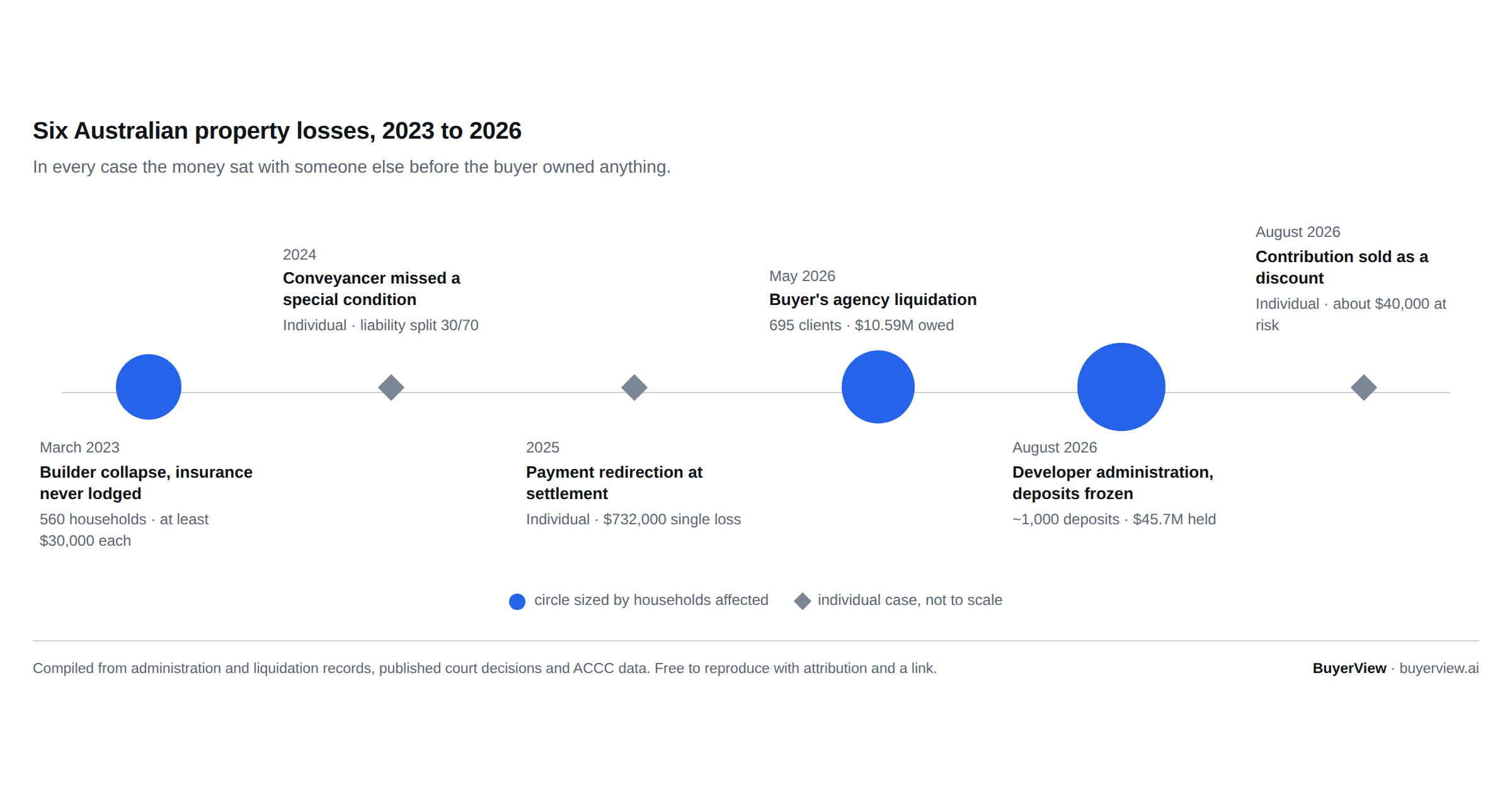
One sentence covers all six. The protection existed, nobody checked it, and the buyer was never told.
Deposits must sit in trust, and nobody tells you which account. Building insurance is compulsory, and nobody verifies it was lodged. A settlement contribution is not a discount, and nothing stops the brochure calling it one. Buyer's agents hold your fee for months, with no trust account rule and no disclosure. Bank details arrive by email, and nothing checks the sender. A conveyancer receives your contract, and what they are obliged to explain to you is never written down.
Six different failures. Same shape every time.
And it is getting larger. In 2023 it was a builder and 560 uninsured families. By May 2026 it was an adviser sitting on $10.6 million of client money with $70,674 left. By August it was a developer with a thousand deposits and $3.19 billion in liabilities, where a man four years into a contract could not work out which of three companies held his $30,000.
| When | What failed | Who it reached | The money |
|---|---|---|---|
| March 2023 | Builder took deposits without lodging compulsory building insurance | 560 families | Most had paid at least $30,000 |
| 2024 | Conveyancer did not explain a special condition or the cooling-off period | First-home buyers | Liability split 30% conveyancer, 70% building inspector |
| 2025 | Payment redirection at settlement | National | $166.8M lost in 2025; one buyer lost $732,000 |
| May 2026 | Buyer's agency liquidation, fees paid upfront | 695 clients | $10.59M owed, about $70,674 recoverable |
| August 2026 | Developer administration, deposits unrefundable | ~1,000 deposits | $45.7M in customer deposits |
| August 2026 | Settlement contribution marketed as a discount | Individual buyers | About $40,000 at risk per buyer |
Compiled by BuyerView from administration and liquidation records, published court decisions and ACCC data. Free to reproduce with attribution and a link.
Which is why the tax reform is the wrong thing to be reading closely. It changes what a property is worth to an investor. It will never change who is holding your money next Tuesday.
That gap is why BuyerView exists. When buyers ask their questions at open homes on the record, the answers stay attached to the property for everyone who inspects it after them.
Ask your first question at BuyerView → 🏠
Frequently asked questions
What happens to my deposit if a property developer goes into administration?
In NSW the Conveyancing Act 1919 generally requires off-the-plan deposits to be held in a trust or controlled money account rather than released to the developer, so the money usually still exists. That does not mean you can demand it back because the developer went into administration. You need a right under your contract to terminate, and rescinding without one can cost you.
How do I find out who is actually holding my off-the-plan deposit?
Ask your conveyancer to name the vendor entity on your contract and confirm in writing which trust account received your money and at which firm. Where a developer runs several related companies, the vendor on your contract may not be the company whose name is on the signage.
Is a developer discount or rebate safe if the developer collapses?
It depends entirely on how it is written. A real discount reduces the price in the contract. A rebate or contribution paid at settlement is an unsecured promise, so if the developer fails you may have to find that money yourself at a settlement you cannot walk away from. Ask which one you have before signing.
How do I protect myself if a buyer's agent collapses?
Buyer's agent licensing varies from state to state, and the industry's own peak bodies have called it unregulated. Ask to see a professional indemnity certificate rather than take anyone's word for it, check the licence on your state authority's register, pay in stages tied to milestones instead of in full upfront, and ask in writing what happens to prepaid money if the firm stops trading. Industry figures have described fifteen to twenty thousand dollars upfront as an abnormally large amount to hand over.
How do I avoid a settlement payment scam?
Ring your settlement agent on a number you looked up yourself and read the bank details back to them before transferring anything. Treat any change of account details near settlement as fake until you have confirmed it by voice, and be wary of anything sent from a Gmail or Hotmail address.
Sources
ABC News, Bathla Group enters administration · ABC News, administrators notify purchasers · ABC News, apartment buyer facing $40k shortfall · ABC News, 3,472 construction insolvencies to June 2026 · Domain, buyers left in dark as Western Sydney developer collapses · Renee Roumanos Legal, off-the-plan deposits and the Conveyancing Act 1919 · Real Estate Business, amount owed to Dashdot clients · ABC News, Dashdot clients out of pocket · Capital Brief, Dashdot and the tax reforms · WA Consumer Protection, $732,000 settlement scam · ACCC, 2025 scam losses exceed $2 billion · Barry Nilsson, Patterson v Mamou (t/as De Novo Conveyancing) [2024] NSWDC 47 · Real Estate Business, Dashdot and calls for buyer's agent reform · CM Law, off-the-plan valuation risk · ABC News, Porter Davis customers plead for help · ABC News, 560 families left without insurance · ABC News, tender agreement holders ineligible · ATO, negative gearing and CGT reform
About the author: Kumaril Balodhi is the founder of BuyerView (COSTAPPLE PTY LTD, ABN 15 673 435 491), an Australian property Q&A platform that helps buyers ask better questions at open homes before they commit.
The Open Home Report is published by BuyerView. This is general information, not financial advice, and not legal or property advice either. Company information comes from public administration and liquidation records, published court decisions and major news reporting, and is current as at September 2026. Buyers are identified by first name or pseudonym as published in the original reporting.
Something happened to you that other buyers should know about? Tell us at buyerview.ai, or just reply to this email.